We all know someone who embodies the phrase ‘free spirit’.
They are the dreamers, searchers and innovators in life, destined to shine their light briefly into our world and move on.
Experimental, passionate, they pick us up and carry us part of the way with them, before gently setting us down further along our road.
Then they are gone. We see them in the distance, turning to smile and wave back at us, even occasionally racing back to share another moment before disappearing into the woods.
Many of them burn so brightly that they are snuffed out whilst still young. But they leave behind a glow that will light our way for many years to come.
There is a tendency in both our business and private lives to hide how we really feel.
This can lead to us going a long way down a particular road before we are finally forced to admit that it wasn’t the road we would have liked to have been on in the first place.
Life can be very confusing – we have ever more demands placed on us by society, family, work. How do we know what to do for the best?
Is it enough to just put our heads down and soldier on, throwing ourselves into the fray of work and socialising in the hope that it will all work out in the end?
Doing this tends to build up a pool of unexpressed emotions, which over time begin to exert an increasingly negative influence on our relationships, health and careers.
It can really help to take just 5 or 10 minutes a day to be still. Just by sitting in silence (yes, even turn off the phone) and breathing regularly, we will begin to discover and appreciate what is of most importance to us.
You don’t have to do anything except be still and breathe regularly. Don’t try to focus or concentrate – just relax.
If thoughts bubble up, just be calm and watch them disappear again.
Over time, the discipline of sitting still and breathing regularly in silence will become something that you look forward to each day.
Eventually, you will find that you become more intuitive and that life is easier to cope with.
You will be more connected to yourself and your emotions – and will make better, more informed decisions.
It won’t happen the first time you do it (unless you’re very lucky) and the effect is quite subtle.
But in time, you will wonder how you ever got by without it.
Around 500 BCE, the Buddha said that life is suffering. This was such an important revelation for him that it was the first of his 4 Noble Truths.
Today, over 2500 years later we may use different words or longer phrases to describe our experience of life, but his words remain intrinsically true.
Everyone who is born will die. Sorry to ruin your cornflakes, but this is a truth that cannot be avoided.
No-one alive can avoid experiencing loss of some kind or another and for each of us it is raw and painful when it happens.
Whether it is a cherished brother or sister, our partner, a child or a doting parent – at some point in all our lives we will experience the intense and lonely agony of loss.
It is at these times when we feel that we are the only ones suffering – that we are totally alone in the world. Life becomes suffering.
The good news is that you have a pool of over 7 billion people who know exactly how you feel. They have all lost someone or something precious too. They understand. You just don’t know it.
So the best way to deal with loss (after the initial shock) is to reach out. Connect with another human and tell them your story. It takes courage, because not everyone is ready to help others. But you will find someone who responds and it will help you both.
When you realise how much you were helped by one person connecting with you, you will do the same for others. And this will help you even more.
Through sharing our stories of loss and of those who touched our lives (however briefly), we can help someone else to feel less alone and that is an amazing thing to be able to do.
Close your eyes and listen to this beautiful song by the Carpenters – Superstar. It’s not directly about death – but the sense of loss, longing and loneliness that is conveyed in this song is incredibly powerful – and ultimately uplifting. Listen, then be open to connecting with someone – you never know how much you can help until you try.
One of the most over-used words in business and public life today is ‘challenge’.
It has become a noun, usually employed in the context of euphemistically referring to some major foul up: “Yes, the fact that our MD ran off with the cleaner and all our money presents us with a challenge, but…”
The language of business and politics today won’t allow us to use words like ‘problem’, ‘issue’ or indeed ‘foul up’ to describe the multitude of things that go wrong on a daily basis. Challenge, the noun, is used to demonstrate that the speaker is in control, has command of the situation and is in the process of dealing with it.
Its prevalence as a noun came out of the growth in use of NLP (Neuro Linguistic Programming) techniques in Public Sector and business training courses.
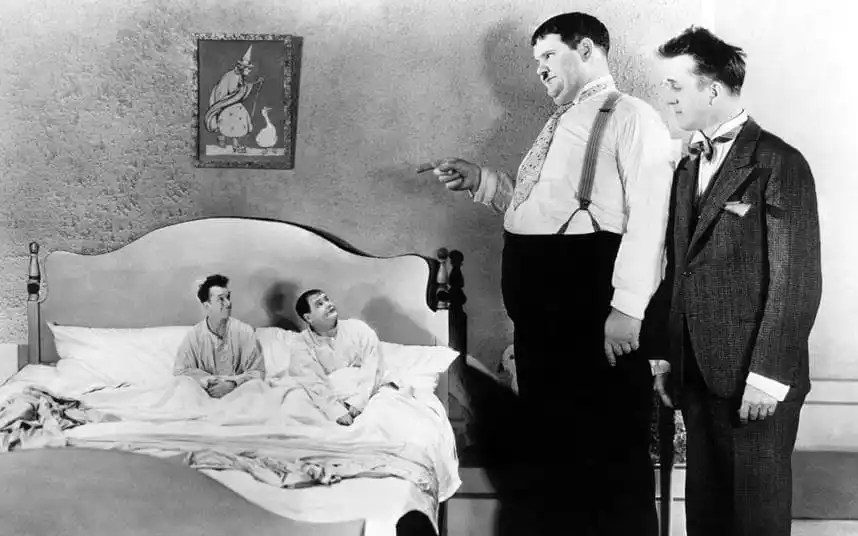
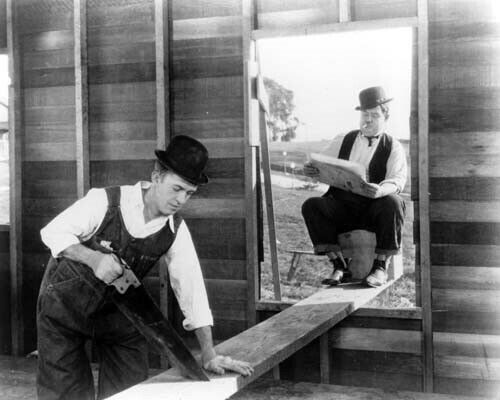
“Well, here’s another challenge you’ve gotten me into, Stanley”
In contrast to the sanitising effect of the noun ‘challenge’, the verb ‘to challenge’ carries with it immense power.
As a verb, ‘challenge’ is a dynamic word – it implies thought, courage and a desire to push the boundaries.
It is what we should all be engaged in: challenge what you read in the press, see on TV or hear our political and business leaders tell us.
Don’t wordlessly accept what you are told, don’t let other people tell you what you should be thinking.
In this context, ‘to challenge’ does not imply violence or aggression – but integrity, a desire to make things better.
Ask questions, make sure that there is proper scrutiny, show us the facts.
Don’t be content to let other people re-frame your life – challenge them, then challenge yourself to keep on asking questions.
What inspires us to follow our dreams or to try something new? For each person the answer will be different – perhaps the words of a great leader from history, such as Gandhi, Winston Churchill or George Washington.
For some, it will be the connection to the divine expressed through spiritual leaders such as Muhammad, Christ or Buddha.
Or the feats of an athlete or sportsman, such as Michael Johnson, Usain Bolt or Cristiano Ronaldo.
We all need to be inspired in some way in order to push ourselves beyond our comfort zone.
For me, the most effective inspiration comes from those who care about us and show confidence in us. Buoyed by their faith, we can push ourselves further, try harder and for longer.
Those who are close to our hearts really can inspire us to do anything by showing faith in our abilities and encouraging us to try new ventures.
And the great thing is – it works both ways. If we can be inspired by the words of a loved one or close friend, we can do the same for others.
We all have the capacity to show someone that they are special and to set a great example for them. And with this capacity comes a responsibility: to share our passion, to do our best, to make a difference and to thank those that help us through the darkness.
For life can be hard at times and it is easy to get lost in the day to day drama of it all and let our dreams fade away with the passing of time.
Everyone has the capacity to be the light in someone’s life. If we reach out, connect and encourage, we will be amazed at what we can inspire others to do.
If you listen to the politicians and media, you would think that the public and private sectors are inhabited by completely different species.
Ideologies have replaced common sense, soundbites in place of rational discussion.
If we are really all in this together, the only way we can progress is to understand each other more.
My work involves dealing with both the public and private sectors – business owners, local authority officers, business group leaders and local, regional and national public sector leaders.
I can honestly say that I have yet to come across anyone in any of these organisations who does not sincerely want to give of their best – whether to help businesses to achieve their full potential or to grow their own business and employ more people.
Where it all tends to get a bit bogged down, unfortunately, is in the communication. Both the public and private sectors have their own terminology and jargon – this can be confusing for both sides.
Having worked with both the public and private sectors, I often come across situations where Local Authority officers and small business owners can be talking for a length of time without either truly understanding the needs of the other.
This is not always the case with larger businesses, who tend to be run by folks who know the language of the public sector and can adapt their own language to accommodate this.
However, a large number of small and micro businesses do not engage with the public sector at all – they do not understand the language and jargon used and therefore do not trust that help will be there for them.
So, my plea is an old one, but still valid: to the public sector, try not to use jargon and ‘public sector speak’ when addressing or seeking to engage with small businesses; to the private sector, realise that there is a lot of help out there if you put in the effort to understand what it is that is being offered.
We hear a lot about work/life balance these days and it can mean different things to different people.
Some think we have the work/life balance right if we work from home. On the surface, this seems like a reasonable assumption: we have the technology and tools to do so (unless we are actually involved in making things) and whilst ‘working from home’ we can watch over the kids, do the laundry and save the environment by not driving to work.
Whilst working for an employer, I found the freedom and responsibility of working from home very liberating and empowering. Discipline had to be instilled at an early stage and I did this by changing into ‘work clothes’ in the morning when it came to the appointed time to start work. I then changed out of the work clothes once I had finished for the day.
This was important in creating a space between home and work, mentally separating the two environments. It worked very well for me and my time working from home for an employer was both productive and enjoyable.
Then I set up my own company and tried to run a business from home. Even though I was doing much the same work for some of the same people, I quickly discovered that it wasn’t working for me in the same way as before. And the reason why it wasn’t surprised me.
Once I was running my own company, the home became more than a secondary office or a spoke in a wheel of other folks working for one separate entity. My home was the business premises, the head office and the place where all the work was done.
It also was the place where all the invoices were processed, payments made, planning conducted from, PAYE sorted out, tenders written and where the post arrived. Suddenly, it wasn’t a home at all – it was an extended office. It became impossible to switch off – every time I passed the office, I was reminded that I still had to issue an invoice or update the accounts, plan the next marketing strategy or buy a new printer.
So I rented a small office a couple of miles from my home and moved all my work stuff in there. At the end of the day, I could close the door on it and come home. If I needed to, I could bring something back with me and finish it off at home: but this was now a choice and not a constant reminder of what needed doing.
And so to the moral of this particular story: what works well in one situation may not necessarily be right for another. It is important to be alive to the need to constantly question and evaluate what you are doing to ensure that it is being done for the right reasons and not out of habit. Achieving balance is not a one time event – it needs constant review and assessment.
The further away you are from something, the more you realise how much it means to you.
I was born and raised in Plymouth, but have not lived there for over 20 years. My family still live in the City, so I have been back to visit regularly. But I didn’t really see the City as it is – more as I remembered it from my childhood and adolescence.
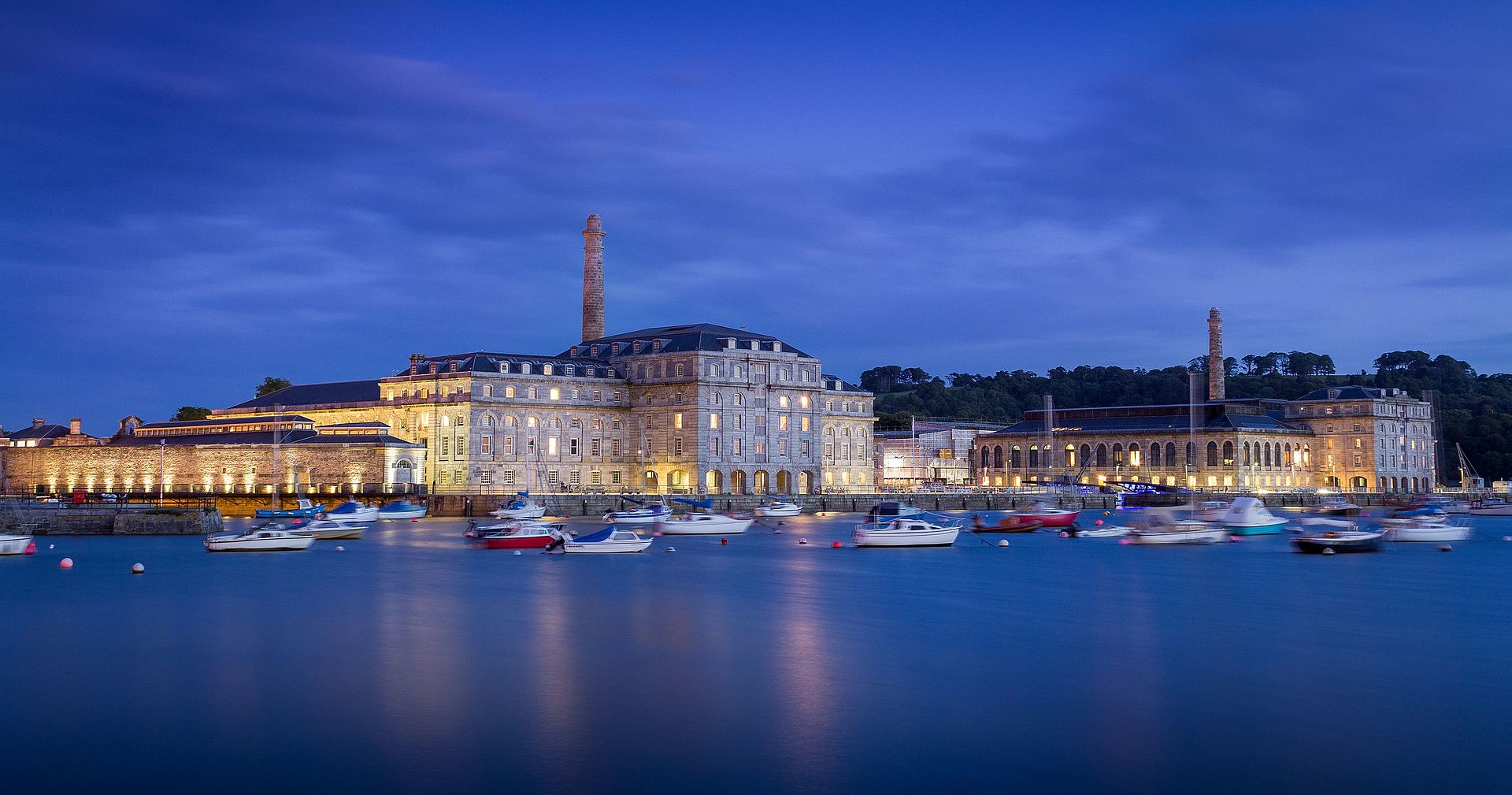
Recently, however, I have gained a renewed love of the City by seeing it through the eyes of business owners in Royal William Yard. It is a City that is now showing signs of fulfilling some of the huge potential that has always bubbled away just beneath the surface.

 run out.




 Love Rules